


The Income Stack: How to Engineer Financial Freedom, One Stream at a Time
A research-backed, difficulty-graded roadmap for beginners, professionals, and experts
Financial freedom isn’t a lottery ticket or a lucky trade. It’s an engineering problem – and like any engineering problem, it has a known set of components. There are eight recognized types of income, and decades of research on wealthy households confirms that the people who reach financial independence almost always end up owning a working combination of several of them, not just one. This article breaks down each of the eight income types, grades how easy or hard each one is to set up and backs the strategy with data from academic research centers, Federal Reserve studies, and the financial industry’s most cited datasets – closing with a full list of sources so you can verify every number yourself.
Why “One Income” Is a Fragile Strategy
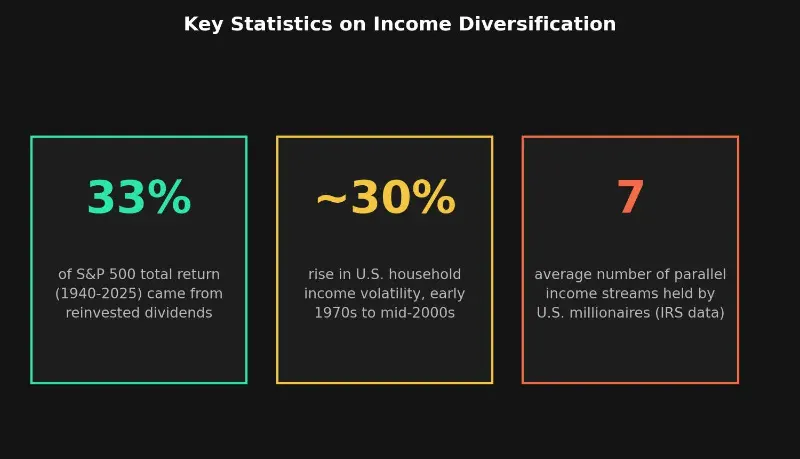
Most people are taught to optimize for a single income stream: a job. It’s the default script – study, get hired, get promoted, retire on savings. The problem is structural, and it’s measurable. Federal Reserve research on household income has found that income volatility for U.S. households rose by roughly one-third between the early 1970s and the mid-2000s, driven mainly by fluctuations in hours worked and hourly pay. More recently, the Federal Reserve’s own Survey of Household Economics and Decisionmaking found that 3 out of 10 adults report their income varies from month to month, and for one in ten of them that variability translates directly into difficulty paying bills. A single income source means a single point of failure – a layoff, an injury, or an industry disruption can erase 100% of your cash flow overnight. Financially independent individuals, and increasingly financially savvy professionals at every career stage, deliberately diversify the type of income they earn, not just the source, because different income types respond differently to economic shocks.
The 8 Types of Income, Explained and Graded
Below is a breakdown of all eight income types. Each includes what it is, real-world examples, and a Setup Difficulty Grade – Easy, Moderate, or Difficult – based on the capital, skill, and time typically required to get it running from zero.
- Earned Income [EASY SETUP]
You exchange your time and skills directly for money. This is the income type almost everyone starts with.
- Salary
- Hourly pay
- Freelance work
- Consulting
Limitation: once you stop working, the income usually stops too. It scales with hours, not leverage.
- Profit Income [MODERATE SETUP]
This is the money left after all expenses are paid – the reward for running something, not just staffing it.
- Running a business
- Selling products
- Side businesses
- Consulting practices with overhead
Sell something for $100 that costs $40 to make, and your $60 difference is profit. This income rewards skill, strategy, and smart decisions more than hours worked.
- Interest Income [EASY SETUP]
You earn this by letting others use your money. Banks and financial institutions pay you interest for using those funds.
- Savings accounts
- Fixed deposits
- Bonds
Generally lower risk, but returns can be modest and may struggle to beat inflation – this is a foundation, not a destination.
- Rental Income [MODERATE SETUP]
You earn it by letting someone use an asset you own.
- Real estate
- Short-term rentals
- Vehicles
- Equipment
A rental asset can generate regular cash flow while remaining yours – but it requires upfront capital and some ongoing management.
- Capital Gains Income [MODERATE SETUP]
This is the profit made when you sell an asset for more than you paid.
- Stocks
- Real estate
- Businesses
Buy an asset at a lower price and sell it later when its value rises. Time and patience do much of the work here – it demands discipline more than daily effort.
- Dividend Income [EASY SETUP]
This comes from owning shares in dividend-paying companies. These businesses return part of their profits to shareholders, with payments arriving quarterly or annually.
The benefit? You can earn income without selling your shares. Research from Hartford Funds and Morningstar covering 1940-2025 found that reinvested dividends accounted for an average of 33% of the S&P 500’s total return over that period.
- Royalty Income [DIFFICULT SETUP]
You earn this from intellectual property you own or create.
- Books
- Music
- Software
- Digital content
- Licensed ideas
Create it once, and it can continue generating income over time – but reaching a quality and distribution level where royalties matter usually takes sustained creative or technical effort.
- Residual or Leveraged Income [DIFFICULT SETUP]
This sits between earned income and asset income.
- Affiliate marketing
- Digital products
- Online courses
- Subscription businesses
It takes time to build, but eventually systems can scale it beyond your working hours – the difficulty lies in the initial build phase, not the payoff.
Setup Effort at a Glance
| # | Income Type | Setup Grade | What Drives the Difficulty |
| 1 | Earned Income | Easy | Anyone can start immediately with existing skills |
| 2 | Profit Income | Moderate | Requires a product/service, customers, and operations |
| 3 | Interest Income | Easy | Just needs an account and available capital |
| 4 | Rental Income | Moderate | Needs upfront capital and asset management |
| 5 | Capital Gains Income | Moderate | Requires market knowledge, patience, and risk tolerance |
| 6 | Dividend Income | Easy | Just need a brokerage account and consistent investing |
| 7 | Royalty Income | Difficult | Requires original creative/technical work and distribution |
| 8 | Residual/Leveraged Income | Difficult | Requires systems-building, audience, and long ramp-up time |
What Research Actually Shows
The “diversify your income” advice isn’t folk wisdom – it’s one of the most consistently replicated findings in personal-finance research. The most cited study on this comes from Thomas C. Corley’s five-year “Rich Habits” research project, which tracked the financial behaviors of 233 self-made millionaires and found a clear pattern in how many income streams they built before reaching their first million:
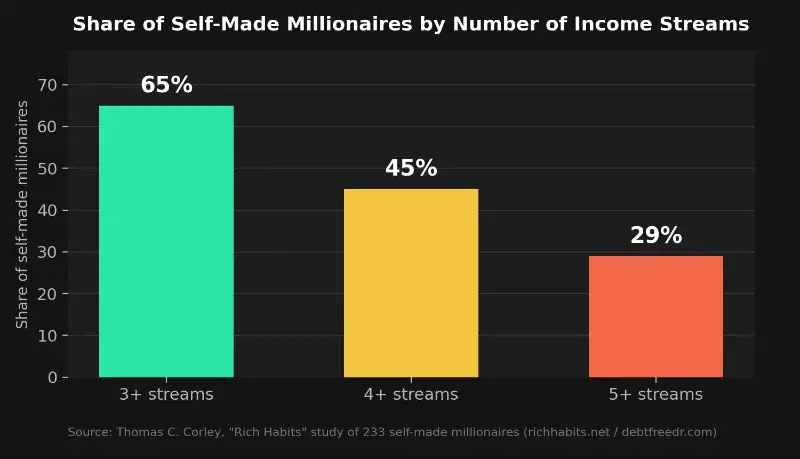
Figure 1: Share of self-made millionaires by number of income streams. Source: Thomas C. Corley, “Rich Habits” study.
Separately, IRS income-reporting data cited across multiple financial outlets shows that the average millionaire maintains seven distinct income streams at the same time – not sequentially but running in parallel. The pattern holds regardless of which dataset you use: three streams appear to be a minimum threshold for resilience, five streams is where most self-made wealth builders land, and seven-plus is common among those who have already arrived at financial independence.
Figure 2: Key statistics on income diversification, compiled from Hartford Funds/Morningstar, Federal Reserve, and IRS data.
The Rise of the Side Hustle Economy
Building a fourth- or fifth-income stream today is more accessible than it has ever been, largely because of the growth of digital side-income channels. Bankrate’s 2025 Side Hustle Survey found that roughly 27% of U.S. adults maintain a side hustle in addition to their main job, earning an average of $885 a month, with income varying sharply by generation:
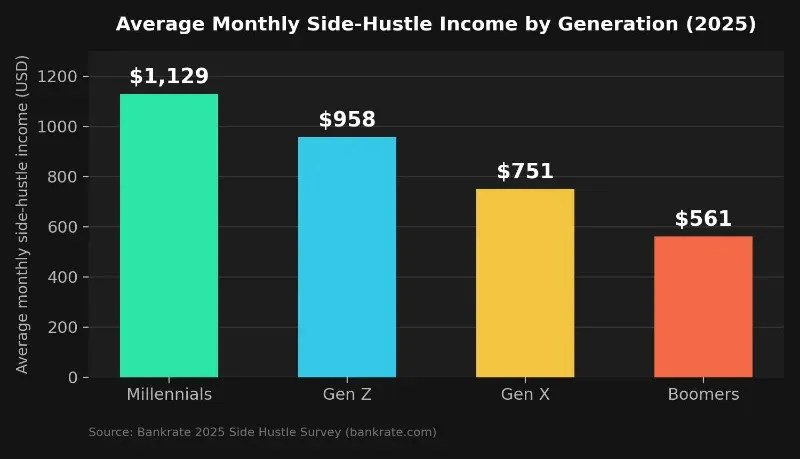
Figure 3: Average monthly side-hustle income by generation, 2025. Source: Bankrate 2025 Side Hustle Survey.
Side hustles rarely qualify as fully “passive,” but they’re often the fastest practical route into Profit Income or Residual/Leveraged Income for someone who is still primarily reliant on Earned Income. The trend also confirms something important: younger generations are building extra income streams earlier in their careers than previous generations did, which compounds the benefit over a longer time horizon.
Financial Literacy: The Multiplier Behind Every Stream
None of the eight income types compound effectively without a baseline of financial literacy. Research from Annamaria Lusardi (George Washington University, formerly Dartmouth College) and Olivia S. Mitchell (Wharton School, University of Pennsylvania), published through the National Bureau of Economic Research and the Global Financial Literacy Excellence Center, has repeatedly found that financial literacy is closely tied to retirement planning and long-term wealth accumulation, and that the causal relationship runs from planning to wealth – not the other way around. In practice, this means the “easy” income types in this article (interest, dividends, earned income) are also the ones with the lowest barrier to financial-literacy entry, which is exactly why they make sensible starting points before tackling harder, less liquid streams like royalties or leveraged digital businesses.
Why Building Any 5 of These 8 Matters – For Everyone
The reason financial planners keep repeating “diversify your income” isn’t a cliche – it’s math, and it’s now backed by decades of Federal Reserve and academic research. Each income type reacts differently to inflation, market downturns, job loss, and time constraints. Earned income disappears the moment you stop working. Interest income erodes under high inflation. Capital gains and dividend income depend on markets doing reasonably well. Royalty and residual income are largely immune to hours worked but take longest to build. When you hold five or more of these simultaneously, a shock to any one of them rarely threatens your overall financial position – the others carry you through, which is precisely the mechanism the Corley “Rich Habits” data and Federal Reserve volatility research both point to independently.
This isn’t advice reserved for the wealthy or the entrepreneurial. It applies with equal force across every stage of a working life:
| Beginners / Students | Start with what’s accessible: earned income from a job or freelance gig, interest income from a savings account, and dividend income from small, consistent index-fund investing. These easy-grade streams build the habit and capital base for harder ones later. |
| Salaried Professionals | Your earned income is stable but capped. Layer in dividend income, capital gains from long-term investing, and rental income if capital allows. A side project generating profit income turns spare hours into a fourth or fifth stream without quitting your job. |
| Business Owners | You likely already have profit income covered. The growth move is reinvesting profits into interest-bearing instruments, dividend stocks, or rental property – and exploring royalty or residual income built from your existing expertise. |
| Experts / Established Investors | At this stage priority shifts from acquiring to optimizing. Rebalancing across capital gains, dividends, rental portfolios, and royalty assets – while mentoring or licensing knowledge for residual income – keeps growth compounding with less personal time input. |
The five-stream principle: Across independent datasets – the Corley “Rich Habits” study, IRS income reporting, and Federal Reserve volatility research – the same threshold keeps appearing. Once an individual holds roughly five distinct, functioning income types, exposure to any single point of failure drops sharply, and the path to financial independence accelerates, because at least two or three of those streams are usually growing or compounding passively at any given time.
A Practical Path: Building Your Five
There’s no single “correct” five – the right combination depends on your starting capital, risk tolerance, and available time. But a balanced, realistic sequence for most people looks like this:
- Lock in Earned Income first. It funds everything else. Don’t quit this until your other streams meaningfully replace it.
- Add Interest Income. Build an emergency fund in a high-yield savings account or fixed deposit – the easiest possible second stream.
- Add Dividend Income. Begin systematically investing into dividend-paying stocks or index funds, even in small amounts, as early as possible to let compounding work.
- Pursue Capital Gains Income. As comfort with markets grows, allocate a portion of savings to growth assets and hold with patience.
- Choose one “leverage” stream – Profit, Rental, Royalty, or Residual Income – based on what you have most of: time, capital, or expertise.
Notice that this sequence naturally produces five income types without requiring you to master all eight at once. It also mixes easy-grade streams (which build confidence and capital early) with harder-grade streams (which compound value over the long run). That mix – not any single stream in isolation – is the actual mechanism behind the statistics cited throughout this article.
The Time Factor Nobody Talks About
Every income type on this list trades one of three resources: time, capital, or skill. Earned and profit income mostly trade time and skill. Interest, dividend, and capital gains income mostly trade capital and patience. Rental income trades capital plus ongoing management time. Royalty and residual income trade a large upfront investment of skill and time for a payoff that arrives later but requires very little maintenance time afterward. Bankrate’s data on side hustlers reflects this trade-off directly: hustlers who spend 10+ hours a week on their side income earn meaningfully more than those spending under five, but the highest-leverage streams – royalties and digital products – are the ones designed to eventually decouple income from hours entirely. Understanding this trade-off lets you choose your next stream deliberately, based on which resource you currently have in surplus, rather than chasing whatever income type is trending on social media.
Conclusion: Financial Freedom Is a System, Not a Windfall
Financial freedom is what happens when your income no longer depends on your continued personal effort to sustain your lifestyle. No single income type gets you there reliably – earned income caps out, profit income requires active management, and even passive-sounding streams like dividends or rentals need a real capital base to matter. But when five or more of these eight income types are working together, each compensating for the others’ weaknesses, the system becomes resilient by design – a conclusion supported independently by Corley’s five-year millionaire study, IRS income-reporting data, Federal Reserve household-volatility research, and decades of financial-literacy scholarship from Lusardi and Mitchell. Whether you’re a student opening your first savings account, a professional negotiating your next raise, a founder scaling a business, or a seasoned investor rebalancing a portfolio, the underlying strategy is identical: identify which of the eight types you already have, grade what it would take to add the next one, and build deliberately toward at least five.
References
- Corley, Thomas C. “Rich Habits” study of 233 self-made millionaires (five-year research period). As summarized in “7 Streams of Income: How the Average Millionaire Builds Wealth,” DebtFreeDr.com: https://www.debtfreedr.com/7-streams-of-income/
- Corley, Thomas C. “Rich Habits” research, as republished at RichHabits.net: https://richhabits.net/multiple-income-streams-why-65-of-the-rich-never-rely-on-one-paycheck/
- Board of Governors of the Federal Reserve System. Survey of Household Economics and Decisionmaking (SHED). Summarized in “The Financial and Psychological Costs of Income Volatility,” Econofact.org: https://econofact.org/the-financial-and-psychological-costs-of-income-volatility
- Dynan, Karen, Douglas W. Elmendorf, and Daniel E. Sichel. “The Evolution of Household Income Volatility,” Brookings Institution / Federal Reserve Board working paper: https://www.brookings.edu/wp-content/uploads/2016/06/02_useconomics_elmendorf.pdf
- Pew Charitable Trusts. “How Income Volatility Interacts With American Families’ Financial Security”: https://www.pew.org/en/research-and-analysis/issue-briefs/2017/03/how-income-volatility-interacts-with-american-families-financial-security
- IRS income-reporting data on millionaire income streams, as reported in “The Average Millionaire Has 7 Streams of Income, According to the IRS,” Yahoo Finance: https://finance.yahoo.com/news/average-millionaire-7-streams-income-160022858.html
- 2025 Side Hustle Survey: https://www.bankrate.com/loans/small-business/side-hustles-survey/
- Hartford Funds and Morningstar. “The Power of Dividends: Past, Present, and Future”: https://www.hartfordfunds.com/insights/market-perspectives/equity/the-power-of-dividends.html
- Lusardi, Annamaria, and Olivia S. Mitchell. “Financial Literacy and Planning: Implications for Retirement Wellbeing,” SSRN / Michigan Retirement Research Center: https://papers.ssrn.com/sol3/papers.cfm?abstract_id=1848593
- Global Financial Literacy Excellence Center (GFLEC), George Washington University: https://gflec.org/wp-content/uploads/2015/09/Annamaria-Lusardi-Paper.pdf
Written for nikhildesh.com – a research-backed guide to structuring income for long-term financial independence.
No Comment! Be the first one.