



Executive Summary
Artificial intelligence has produced the largest, fastest capital build-out in corporate history. In 2026 alone, four hyperscalers — Microsoft, Amazon, Alphabet and Meta — are guiding toward a combined $725 billion in AI-related capital expenditure, up 77% from 2025’s already-record $410 billion. Nvidia has become the most valuable company on Earth. Palantir has posted a Rule-of-40 score of 155%. And yet, underneath the headline numbers, a starkly different picture is emerging: the two companies that anchor the entire AI narrative — OpenAI and Anthropic — are together burning tens of billions of dollars a year, financing that burn with debt, circular vendor deals, and repeated mega-rounds at ever-higher valuations.
This report brings together financial disclosures, market data, and on-the-ground reporting to lay out the case that retail and institutional investors alike should treat AI exposure with real caution. It compares the revenue, expenses, profit and loss of ten leading AI companies; lays out each company’s forecast path (or lack of one) to breakeven; quantifies the volatility already visible in AI-linked share prices; and surveys the geopolitical, environmental, and social pressures — from chip export controls to community protests over water and electricity — that could constrain or derail the sector’s growth.
“Companies are paying to give away their most important secrets, the very basis for their competitive advantage.” — Ryan Taylor, Chief Revenue & Legal Officer, Palantir
The conclusion is not that AI is worthless — clearly, real revenue, real productivity gains, and a handful of genuinely profitable businesses (Nvidia, Palantir) exist inside this boom. The conclusion is that the current wave of investment is bifurcated: a small number of profitable infrastructure and software companies sit atop a much larger base of capital-incinerating frontier labs, debt-financed cloud providers, and speculative capacity that assumes uninterrupted, exponential demand growth. History — from railroads to telecoms to the dot-com bust — suggests that such bifurcated booms eventually correct, and that early, over-leveraged entrants are the ones left holding the losses. This is a risk investors should price in now, not after the correction.
1. Revenue, Expense, Profit & Loss: 10 Leading AI Companies
The starting point for any sober investment case is the income statement. Below is a comparison of ten companies that anchor today’s AI trade — from pure-play foundation model labs to the chipmakers and hyperscalers that supply them. The picture is one of extremes: businesses posting historic losses sitting a few rows away from businesses posting historic profits, all trading under the same ‘AI’ banner.
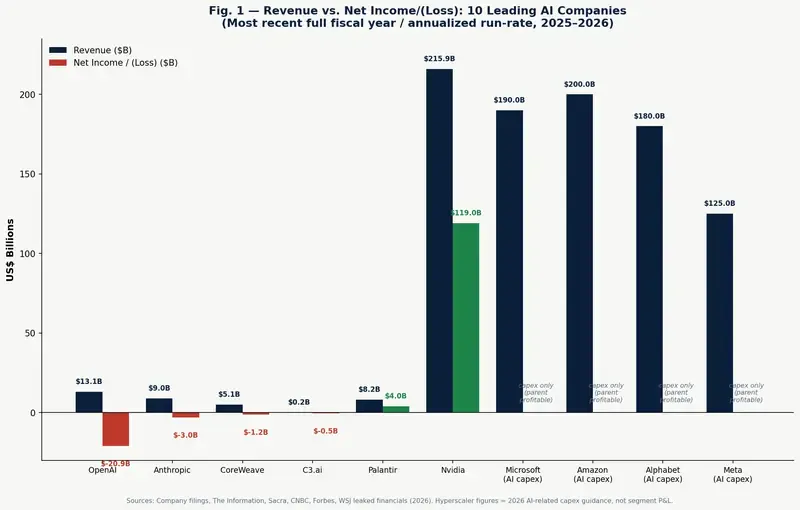
Figure 1: Revenue vs. net income/(loss) across 10 AI-exposed companies, most recent full fiscal year or annualized run-rate (2025-2026). Hyperscaler bars show AI-related 2026 capex guidance, not company-wide P&L — all four parent companies remain overall profitable.
1.1 Company-by-Company Snapshot
| Company | FY Revenue | Net Income / (Loss) | Notes |
| OpenAI | $13.1B (2025 booked); ~$25B ARR run-rate (2026) | -$20.9B (2025 operating loss) | Filed confidential S-1 (Jun 2026); projects ~$14B loss for 2026 alone |
| Anthropic | ~$9B (end 2025); ~$47B ARR (May 2026) | Loss not fully disclosed; structurally smaller than OpenAI’s | Training costs ~4x lower than OpenAI per WSJ/SaaStr analysis |
| Nvidia | $215.9B (FY2026) | ~$119B (est., GAAP) | 75% gross margins; Data Center segment >90% of revenue |
| CoreWeave | $5.1B (FY2025); guiding $12.4-13.2B (2026) | -$1.17B (FY2025); -$626M (Q2 2026 alone) | Debt pile reached $35.6B; 3 customers = 72% of quarterly revenue |
| Palantir | $1.94B (Q2 2026); $8.15-8.16B guided FY2026 | +$1.07B (Q2 2026, GAAP) | Rule of 40 score of 155%; one of the few profitable pure-play AI firms |
| C3.ai | $250.3M (FY2026) | -$498.5M (FY2026, GAAP) | Losses nearly 2x revenue; CEO reinstated after 35% revenue decline |
| Microsoft | AI capex ~$190B guided (2026) | Company-wide profitable | ~$80B Azure backlog unfulfilled due to power constraints |
| Amazon (AWS) | AI capex ~$200B guided (2026) | Company-wide profitable | $176B in active/planned US data-center projects tracked |
| Alphabet (Google) | AI capex $175-185B guided (2026) | Company-wide profitable | Reported 5B+ gallons/yr water use across data centers (2023) |
| Meta | AI capex $115-135B guided (2026) | Company-wide profitable | Signed $35B+ in CoreWeave compute commitments through 2032 |
Table 1: Comparative financial snapshot, 10 AI companies. Figures as disclosed or estimated as of August 2026.
1.2 Reading the Table
- The two most-hyped consumer AI labs — OpenAI and Anthropic — are also, by a wide margin, the two biggest cash burners in the group.
- OpenAI’s 2025 loss ($20.9B) was nearly 8x its 2024 loss, even as revenue grew roughly 3.5x.
- Nvidia and Palantir are the standout exceptions: genuinely, substantially profitable businesses, but both trade at valuations that already price in years of continued hypergrowth.
- ai illustrates the fate of smaller ‘enterprise AI’ vendors squeezed between hyperscaler platforms and frontier labs: a 35% revenue decline paired with a 70% jump in losses.
- The hyperscalers (Microsoft, Amazon, Alphabet, Meta) remain profitable at the corporate level, but they are the ones absorbing the bulk of the capital risk — nearly $725 billion in 2026 capex — on the assumption that AI demand will justify it.
2. Forecasted Breakeven Year: When Do These Companies Turn a Profit?
Breakeven timing is the single most important variable for an AI investor, because it defines how much additional capital — and dilution, or debt — a company will need before its business can sustain itself. For frontier AI labs, that date has consistently moved further away, not closer, even as revenue has scaled.
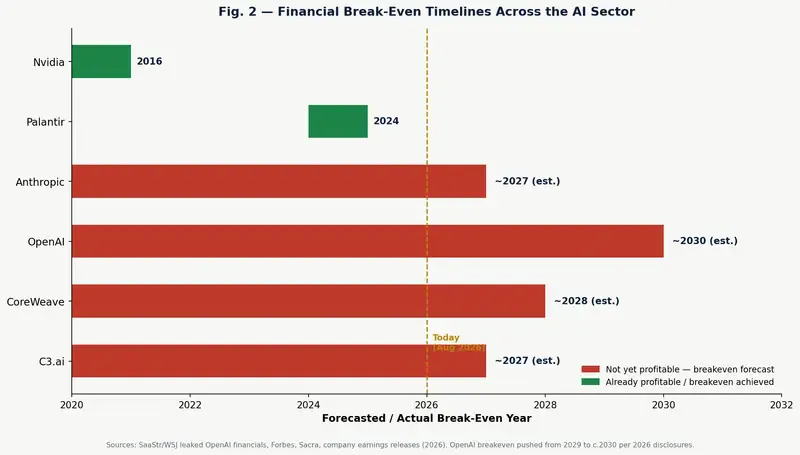
Figure 2: Forecasted or achieved breakeven years across the sector. OpenAI’s own breakeven target has slipped from 2029 to roughly 2030 within the space of a year.
OpenAI’s own financial projections, reported by multiple outlets in 2026, show the company expecting to spend $121 billion on compute in a single year (2028) and still post an $85 billion loss that year — with breakeven not expected until after 2030. Anthropic, by contrast, has told investors it expects positive free cash flow by 2027, helped by training costs roughly a quarter of OpenAI’s for comparable model quality. CoreWeave and C3.ai, both infrastructure-dependent, are targeting breakeven around 2027-2028, contingent on continued hyperscaler demand and successful cost discipline.
“OpenAI is on course to accumulate hundreds of billions in losses before reaching positive cash flow around 2029 or 2030.” — Forbes, May 2026
For investors, the risk is not merely that breakeven is distant — it is that these forecasts have proven unreliable in one direction only: later, not sooner. A model that assumes today’s growth rate continues in a straight line to profitability is a fragile model; any deceleration in revenue growth, any increase in compute costs, or any tightening of capital markets pushes these breakeven dates out further still.
3. Share Price Volatility: A Sector Built for Whiplash
AI-linked equities have exhibited some of the sharpest single-session and single-week price swings of any sector in the current market cycle. Palantir shares fell 29% over the course of 2026 on growth-sustainability concerns, then surged roughly 30% in a single session after a blowout earnings report — a round trip of nearly 60 percentage points inside one year. CoreWeave has swung double digits in both directions around individual earnings releases, driven by its heavy debt load and customer concentration. Even Nvidia, the most profitable company in the group, has seen its stock fail to rally — or fall outright — on ‘good’ earnings when guidance disappoints hyper-elevated expectations.
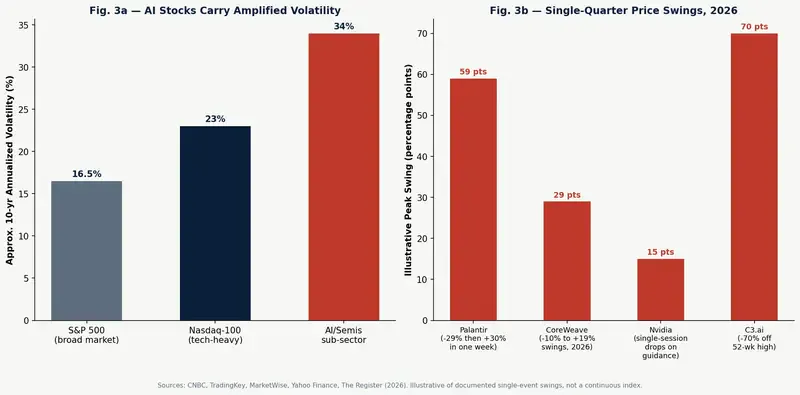
Figure 3: (a) AI and semiconductor stocks carry meaningfully higher annualized volatility than the broad market; (b) illustrative single-quarter price swings recorded in 2026 for select AI-exposed names.
3.1 Why AI Stocks Swing So Hard
- Growth-stock valuation mechanics: prices are built on distant future earnings, so small changes in growth assumptions move the stock disproportionately.
- Market concentration: the top 10 S&P 500 stocks now represent roughly 35% of the index, versus about 25% at the peak of the dot-com bubble, per multiple 2026 analyst notes — amplifying index-wide moves when AI names swing.
- Debt-financed capex: rising interest costs (CoreWeave’s net interest expense more than doubled year-over-year) make earnings more sensitive to financing conditions.
- Headline sensitivity: guidance changes, chip export-control news, and single large customer contracts can each move a stock double digits in a session.
Reuters reported in mid-2026 that ‘the biggest bout of volatility in U.S. stocks in months has revealed cracks in the artificial intelligence-related rally,’ with even Nvidia’s strong earnings failing to lift the broader market — a signal that investor sentiment, not just fundamentals, is now driving price action in the sector.
4. The Widening Gap Between Infrastructure Spend and AI Revenue
Perhaps the single most important chart in this report is the comparison between what is being spent to build AI infrastructure and what AI companies are actually earning from it. The gap has widened every year since 2022, and shows no sign of closing.
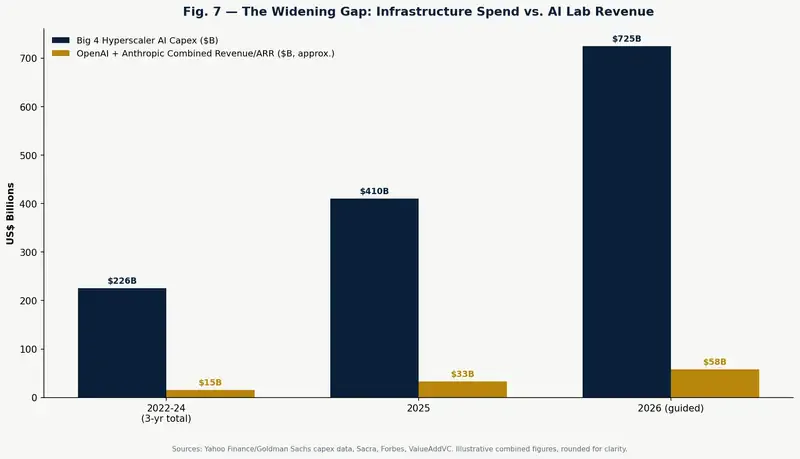
Figure 4: Combined ‘Big Four’ hyperscaler AI capital expenditure vs. combined OpenAI + Anthropic revenue/ARR, illustrative figures rounded for clarity.
McKinsey’s 2025 State of AI survey found that only a minority of enterprises reported that generative AI had meaningfully increased revenue or reduced costs — even as enterprise generative AI spending grew from $1.7 billion in 2023 to $37 billion in 2025. Much of the AI cloud backlog is also concentrated in a small number of counterparties: CoreWeave’s revenue backlog of roughly $104 billion is anchored substantially by contracts with Microsoft, Meta, OpenAI and Anthropic — the same handful of companies that are simultaneously investors in, customers of, and (in some structures) creditors to one another. Analysts have flagged this web of circular, related-party deals as a specific structural risk: revenue and ‘backlog’ figures can look larger than the underlying cash economics justify.
5. Global & Geopolitical Factors Shaping AI’s Future
AI is no longer purely a corporate story — it is now central to great-power competition, trade policy, and industrial strategy, and each of these dimensions introduces investment risk that a pure financial model will miss.
5.1 The US-China Chip War
Export controls on advanced AI chips have become one of the most consequential and volatile levers in US-China relations. In January 2026, the US Department of Commerce shifted its licensing posture for Nvidia’s H200 chip from a ‘presumption of denial’ to ‘case-by-case review,’ allowing exports to China subject to a 50% volume cap relative to US sales and a 25% tariff on each shipment. Congress responded with the ‘AI Overwatch Act,’ seeking to give lawmakers veto power over chip export licenses — a move that introduces the risk that licenses granted by the executive branch could be revoked with little notice. Analysts at the Council on Foreign Relations have described the resulting policy as ‘strategically incoherent.’
For investors, the practical effect is that revenue projections which assume continued or expanded China market access — for Nvidia, AMD, and their customers — now carry meaningful geopolitical risk that most financial models were not built to price. Chip manufacturers with China exposure face renewal uncertainty on a rolling 12-month basis rather than the 3-5 year planning horizon the industry once enjoyed.
5.2 Technology Bifurcation
China’s response has been to accelerate its own semiconductor self-sufficiency — domestic EDA tools, domestic chip architectures, and a 15th Five-Year Plan that names technology self-reliance as a core national strategy. If Chinese memory manufacturers achieve viable HBM3/HBM3E yields on schedule, Nvidia’s competitive window in China narrows further. The longer-term risk is a bifurcated global AI ecosystem — incompatible hardware, software stacks, and safety standards — that fragments addressable markets for every company in this report.
5.3 Sovereign AI and Onshoring
A parallel trend is the rise of ‘sovereign AI’ — governments and enterprises insisting on AI infrastructure and models that never leave their own jurisdiction or network. Palantir’s 2026 growth has been driven substantially by this trend, including a sovereign AI architecture built with Nvidia for air-gapped government facilities. While this creates opportunity for infrastructure and defense-adjacent vendors, it also signals waning trust in the large, US-centric frontier labs among government and enterprise customers worldwide — a headwind for OpenAI and Anthropic’s addressable market outside the US.
5.4 Trade, Tariffs, and Political Volatility
Economist Kenneth Rogoff warned in a widely cited January 2026 column that ‘as investors struggle to assess how AI will affect growth and corporate profits, the odds of a global stock-market crash in the next few years appear uncomfortably high’ — citing AI valuation excess, geopolitical tension, and elevated public debt as compounding risks heading into the 2026 election cycle and a change in Federal Reserve leadership.
6. Water, Space, Skills &Labour: The Physical Limits of AI
AI’s constraints are not only financial — they are physical. Every large language model run on a GPU cluster consumes electricity, water for cooling, land, specialized construction labor, and scarce engineering talent, all of which are becoming binding constraints on how fast the industry can actually grow.
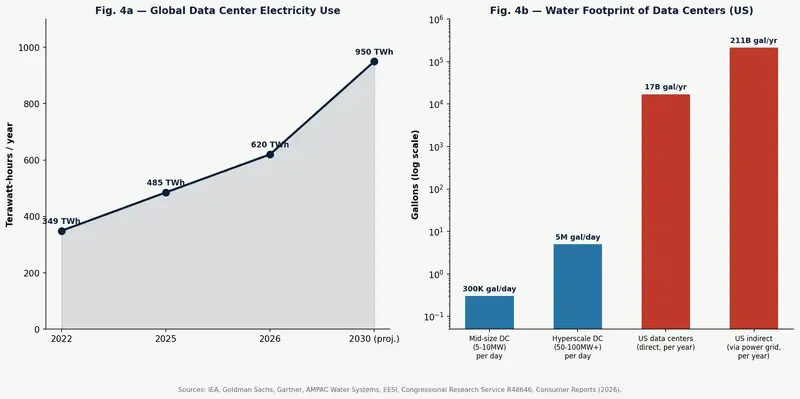
Figure 5: (a) Global data center electricity consumption is projected to nearly triple between 2022 and 2030; (b) the water footprint of US data centers spans from thousands of gallons a day for small facilities to hundreds of billions of gallons a year in aggregate, once indirect power-generation water use is included.
6.1 Water
Estimates of AI’s water footprint vary widely depending on methodology,and researchers have themselves revised early figures downward as cooling technology has improved — UC Riverside’s Shaolei Ren, who produced a widely cited 2024 estimate of roughly 519 milliliters of water per GPT-4 prompt, has since revised that down to approximately 15 milliliters for current systems. Aggregate figures remain large regardless: US data centers’ direct water use is estimated at roughly 17 billion gallons a year, with an additional 211 billion gallons a year of indirect water use tied to electricity generation. Roughly two-thirds of data centers built since 2022 sit in regions already experiencing water stress, including parts of Texas and the Southwest, according to Bloomberg News analysis. Texas data centers alone reportedly consumed over 50 billion gallons of water in 2024.
6.2 Space and Power
Gartner projects worldwide data center power demand will rise 27% in 2026 alone, to 132 gigawatts. In the US, Goldman Sachs estimates power demand will climb from 31 gigawatts in 2025 to 66 gigawatts by 2027. Nearly half of planned AI data centers may not have sufficient power available by 2027, per Gartner — a bottleneck serious enough that Microsoft has disclosed an $80 billion Azure order backlog it cannot yet fulfil purely due to power constraints, and that Sam Altman has personally invested over $375 million in fusion power research to hedge the risk.
6.3 Skills and Labour
A Stanford University study found that 1,953 new AI companies were founded in the United States in a single recent year — ten times more than any other country — yet the arrival of foreign AI researchers and specialists into the US has fallen roughly 80% over the same period, tightening the specialist talent pool precisely as demand for it explodes. Talent retention has also proven fragile even at the top: OpenAI has seen a string of senior departures, including co-founder Ilya Sutskever and members of its founding research team, with many moving to competitors including Anthropic and xAI — a dynamic that analysts have flagged as a genuine risk to OpenAI’s ability to sustain its research edge.
At the same time, the buildout itself requires enormous amounts of skilled construction and trades labour — electricians, mechanical engineers, high-voltage technicians — that is not fungible with the software talent the industry is more commonly associated with, and that is in short supply in many of the regions where new capacity is being sited.
7. Growing Protest Against AI Data Centers Worldwide
Public opposition to AI data centers has moved from scattered local zoning disputes to an organized, international movement in the space of about eighteen months. This is now a material business risk, not a public-relations footnote: opposition has already delayed or cancelled tens of billions of dollars of announced projects.
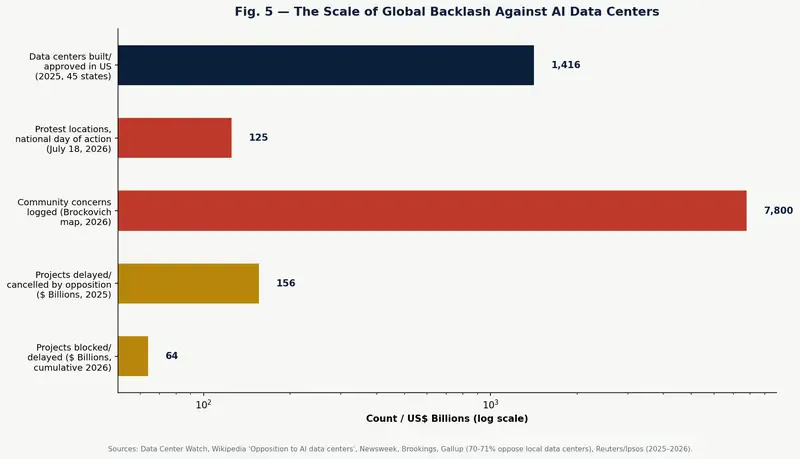
Figure 6: The scale of the backlash — from projects built and proposed to protests, logged community complaints, and dollars of projects delayed or cancelled. Log scale.
In 2025, 1,416 data centers were either built or approved for construction across forty-five US states, triggering opposition over water and electricity use, noise, and the broader concentration of corporate power. On July 18, 2026, a coordinated national day of protest brought demonstrations against AI data center expansion to roughly 125 locations across at least 40 US states. Polling has consistently found this opposition to be broad-based and bipartisan: a March 2026 Gallup poll found 70% of Americans opposed construction of a new AI data center in their own neighbourhood — more than the 53% who said the same about a nuclear power plant — and a June 2026 Reuters/Ipsos poll found only 14% of Americans supported having a data center built in their own community.
“Communities are kept in the dark about who is building these facilities, what backroom deals were made, and what it will cost them in water, noise, and higher electricity bills.” — Data-center protest organizer, quoted in Newsweek, July 2026
Data Center Watch reports that $64 billion of projects have been blocked or delayed by local resistance in 2026 alone, following $156 billion in delays or cancellations in 2025. The phenomenon is not confined to the US: opposition campaigns are documented in Ireland, Mexico, and the UK — including a protest outside Google DeepMind’s London offices in February 2026 — and Waging Nonviolence has described ‘the data center fight going global’ as communities coalesce around shared concerns over water, energy, land use, noise, and the absence of meaningful community consent in permitting processes. In March 2026, seven major technology companies signed a White House ‘Ratepayer Protection Pledge,’ committing to shield residential electricity customers from AI-driven cost increases — itself an acknowledgment of how serious the political pressure has become.
8. Top 10 Countries for Proposed AI Data Centers
Global data center capacity remains heavily concentrated. The United States alone hosts more than double the entire European Union’s data center count, and roughly 51% of the world’s hyperscale AI facilities. The following ranking reflects operating and proposed capacity as tracked by Cloudscene and the Stanford HAI AI Index Report 2026.
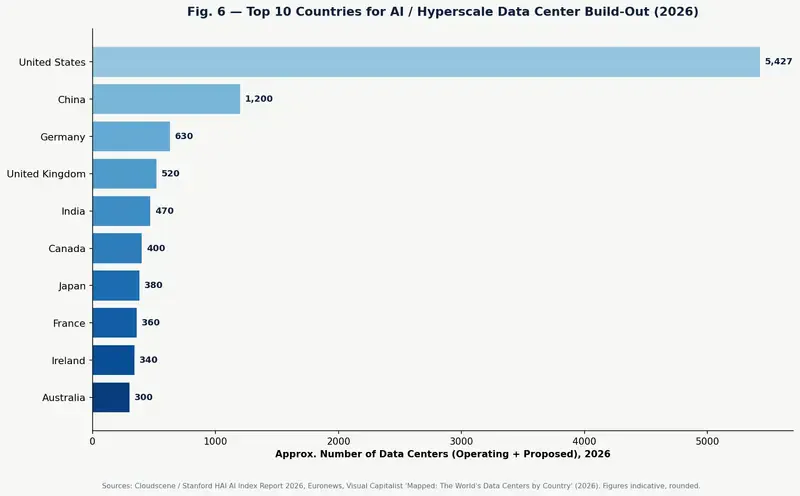
Figure 7: Top 10 countries by approximate data center count (operating + proposed), 2026.
| Rank | Country | Approx. Data Centers | Notable Dynamics |
| 1 | United States | ~5,427 | ‘Data Center Alley’ (Northern Virginia) hosts the world’s largest concentration; federal permitting reforms for 100MW+ projects |
| 2 | China | ~1,200+ | $100B ‘New Infrastructure’ initiative; accelerating domestic chip self-sufficiency amid export controls |
| 3 | Germany | ~630 | Leads Europe; strong grid but rising energy-cost concerns |
| 4 | United Kingdom | ~520 | London site of high-profile 2026 anti-AI protest outside Google DeepMind |
| 5 | India | ~470 | $23B Microsoft investment wave; Hyderabad, Chennai, Pune emerging as hubs |
| 6 | Canada | ~400 | Power-bundled deals attracting hyperscaler investment |
| 7 | Japan | ~380 | Sovereign AI and semiconductor policy driving new capacity |
| 8 | France | ~360 | Mistral AI’s Paris investment signals sovereign-AI-aligned growth |
| 9 | Ireland | ~340 | Long-standing hyperscaler hub; water and grid capacity increasingly contested |
| 10 | Australia | ~300 | Emerging APAC hub with growing hyperscale investment |
Table 2: Top 10 countries for AI/hyperscale data center build-out, 2026. Figures indicative and rounded; sources: Cloudscene, Stanford HAI AI Index Report 2026, Euronews, Visual Capitalist.
9. Other Relevant Risk Factors
9.1 Circular and Related-Party Financing
A growing share of the AI ecosystem’s reported ‘backlog’ and revenue is generated through deals where the same small set of companies act simultaneously as investor, customer, supplier, and creditor to one another — Nvidia investing in customers who buy its chips; OpenAI and Microsoft, Meta, and Oracle locked in multi-hundred-billion-dollar compute commitments; CoreWeave financed substantially by debt to build capacity pre-sold to a handful of counterparties. This concentration means that a shock to any single large participant — a demand slowdown at OpenAI, for instance — could cascade through supplier and creditor balance sheets across the sector.
9.2 Debt Financing and Interest-Rate Sensitivity
CoreWeave’s debt pile reached $35.6 billion by mid-2026, with net interest expense more than doubling year-over-year to $640 million in a single quarter. Oracle bonds took a hit in 2026 on news the company plans to increase debt to finance AI infrastructure, and lenders have begun seeking greater protection on loans tied to major AI buildouts. This makes large parts of the sector unusually sensitive to interest-rate and credit-market conditions relative to the broader technology industry.
9.3 Regulatory and Legal Exposure
Artists, journalists, and writers continue to pursue copyright litigation against AI companies over training-data use. State-level responses to the data-center backlog are accelerating — Florida has passed measures to protect residents from AI-related energy costs, Utah’s legislature is moving to require more reporting on data center impacts, and Ohio homeowners have successfully challenged zoning decisions. A patchwork of state and local restrictions raises the cost and slows the timeline of new capacity across the country.
9.4 Concentration and Valuation Risk
The top 10 stocks in the S&P 500 — heavily weighted toward AI-exposed names — represented roughly 35% of the index in 2026, compared with about 25% at the peak of the dot-com bubble. The Shiller Cyclically Adjusted Price-to-Earnings ratio exceeded 40 in 2025, a level reached only once before in history, immediately preceding the dot-com crash. Unlike 2000, today’s AI leaders (Microsoft, Nvidia, Alphabet) are genuinely, heavily profitable — but that does not protect smaller, more speculative names in the same trade from a sharp correction if sentiment turns.
9.5 Environmental and Emissions Footprint
AI-specific data centers are estimated to emit 50-75 million tonnes of CO2 in 2026, with total AI-workload emissions potentially reaching 1.4% of global CO2 emissions by 2030 — a growing target for ESG-focused investors and regulators alike, and a potential source of future compliance costs or carbon-pricing exposure.
10. Conclusion: Can Investors Really Lose Everything?
Yes — and the mechanism by which they could is now visible in the data, not merely speculative. A company burning $20 billion a year, financed by successive private mega-rounds and vendor credit rather than operating cash flow, is fundamentally dependent on capital markets remaining open and enthusiastic indefinitely. If sentiment turns — because of a geopolitical shock to the chip supply chain, a regulatory crackdown triggered by community backlash over water and power, a credit event at a heavily leveraged infrastructure provider, or simply the normal cyclical correction that has followed every prior period of technological over-investment — the companies furthest from profitability, carrying the most debt, and most dependent on a small number of counterparties are the ones most exposed to a total loss of equity value.
This does not mean AI itself is a bubble in the sense of lacking real value; the productivity gains, revenue growth, and profitable businesses documented throughout this report are genuine. It means the current allocation of capital across the sector is uneven, and that investors buying broad AI exposure today — through public equities, venture co-investment vehicles, or thematic funds — are buying a basket that includes both durable, profitable infrastructure businesses and highly leveraged, pre-profit bets on continued hypergrowth. Distinguishing between the two, and sizing positions accordingly, is the central task for anyone investing in this sector through the remainder of this decade.
Key Takeaways for Investors
- Separate profitable infrastructure and enterprise-software plays (Nvidia, Palantir) from pre-profit frontier labs and debt-financed cloud providers (OpenAI, CoreWeave, C3.ai) before sizing any position.
- Treat breakeven-year forecasts from AI labs as directional, not reliable — they have moved later, not sooner, every time they have been revised so far.
- Price in geopolitical risk explicitly for any company with China chip-supply-chain or China-market-access exposure.
- Monitor local and state-level data-center opposition as a genuine operating risk, not just a reputational one — it has already delayed or cancelled over $200 billion in projects across 2025-2026.
- Watch debt levels and related-party/circular deal structures closely; they are the transmission mechanism by which a single company’s stumble could cascade sector-wide.
- Diversify across the AI value chain and time horizon rather than concentrating in the most-hyped, least-profitable names.
About the Author
Nikhil Deshpande is a Mumbai-based senior program and project management professional with approximately 20 years of experience spanning IT infrastructure, security, network, and transformation domains across the APAC, EMEA, and US markets. He writes on technology, markets, and macro trends at nikhildesh.com, where this article was originally published.
Read more at https://nikhildesh.com
Sources & References
- The Information / ValueAddVC, “OpenAI: $25B a Year, $14B Loss — Inside the Math (2026)”
- at, “Exclusive: OpenAI Losses Increased Nearly 8X in 2025” (Aug 2026)
- Forbes, “OpenAI And Anthropic Are Testing Two Very Different AI Business Models” (May 2026)
- Sacra, “Anthropic revenue, valuation & funding” (Jul 2026)
- SaaStrAI, “Anthropic Just Passed OpenAI in Revenue” (Apr 2026)
- CNBC, CoreWeave Q1/Q2 2026 earnings reports; The Register, “CoreWeave revenue doubles as debt pile reaches $35.6B”
- Sacra, “CoreWeave revenue, valuation & funding”
- CNBC / 24/7 Wall St. / TechTimes, Palantir Q2 2026 earnings coverage
- NVIDIA Newsroom, Q2/Q4 FY2026 financial results releases; Tech Insider, “Nvidia Earnings 2026”
- ai, Fiscal Q4 & FY2026 results (SEC 8-K, BusinessWire); Motley Fool coverage
- Yahoo Finance / Futurum Group / ValueAddVC, 2026 hyperscaler AI capex analyses
- Jacobin, “Critics of AI Aren’t Anti-Tech Extremists” (Jul 2026)
- Wikipedia, “Opposition to AI data centers” (2026)
- Newsweek, “National day of protest against data centers on July 18” (Jul 2026)
- Brookings, “Data center moratoriums are not a substitute for oversight”
- Waging Nonviolence, “The data center fight is going global” (Jul 2026)
- The Intercept, “The Race to Build AI Data Centers — Before the People Can Protest” (May 2026)
- The Queen Zone, “Americans are protesting AI data centers in 125 locations”
- Euronews, “Which country in Europe has the most data centres” (Apr 2026); Visual Capitalist, “Mapped: The World’s Data Centers by Country” (2026)
- BlackRidge Research, “Top 7 Largest AI Data Center Companies in the World 2026”
- East Asia Forum / TechPolicy.Press / BISI / Chatham House / Oplexa, US-China chip export control coverage (2026)
- AMPAC Water Systems, “AI Data Center Water Crisis 2026”; Consumer Reports, “AI Data Centers: Big Tech’s Impact”
- Lincoln Institute of Land Policy, “Data Drain: The Land and Water Impacts of the AI Boom”
- Forbes, “How Much Water Does AI Use? The $58 Billion Risk” (Jul 2026)
- TechCrunch, “Nearly half of AI data centers may not have enough power by 2027”
- Colombia One, “The AI Dilemma: Growing US Opposition to Data Center Construction” (Aug 2026)
- Motley Fool, “Experts Are Sounding the Alarm Over an AI Bubble” (Jul 2026); IntellectIA, “AI Investment Bubble 2026”
- Reuters (via MarketScreener), “Bubble trouble: AI rally shows cracks as investors question risks”
- Business Standard, Kenneth Rogoff, “AI euphoria to geopolitics: Why markets look strangely unprepared for 2026” (Jan 2026)
Disclaimer: This article is for informational purposes only and does not constitute financial or investment advice. Figures are drawn from public disclosures and third-party reporting as of August 2026 and may be revised. Consult a licensed financial advisor before making investment decisions.


No Comment! Be the first one.