


INFRASTRUCTURE / 2026 UPDATE
Revisiting the Case for Nutanix Over VMware
The original argument was architectural: simpler management, easier scaling, better performance,
lower cost. Four years and one Broadcom acquisition later, here’s how those claims hold up against
what Nutanix has actually shipped, earned, and been rated on through 2026.
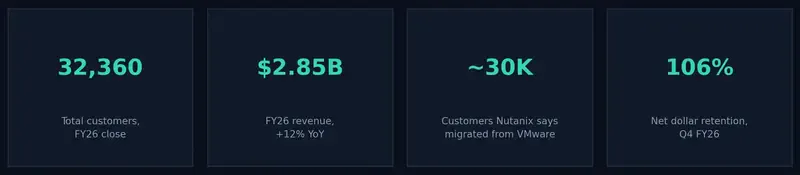
Key figures — FY2026 close
The original pitch for Nutanix over VMware rested on four familiar pillars: a simpler console, easier
scaling, better performance, and a lower total cost of ownership. Those arguments were reasonable
in isolation, and versions of them appeared in nearly every hyperconverged infrastructure vendor’s
sales deck for a decade. What has actually reshaped the market since isn’t a feature checklist — it’s
Broadcom’s November 2023 acquisition of VMware and the licensing, bundling, and pricing changes
that followed. That single event turned a technology argument into a market one. Below, each of the
original claims is checked against what shipped in Nutanix’s 2026 release train — AOS 7.6, AHV
11.2, Prism Central 7.6, and the Enterprise AI line — and against real financial results and
independently collected customer reviews, rather than vendor messaging.
01 — MANAGEMENT
The single-console argument is now table stakes
Prism Central is still Nutanix’s unified control plane, but the engineering effort in 2026 has visibly
shifted from “one console” novelty toward operational hardening. AHV 11.2 disables external SSH
access to hosts by default and adds cluster-wide control over host console access, while AOS 7.6
adds centralized storage management and broad reliability improvements alongside RHEL 9 support
for Controller VMs and Prism Central. Prism Central 7.6 even added the ability to copy and paste text
into a VM console — a small detail, but a sign of a platform polishing edges rather than still selling
the idea of a unified console as differentiation.
VMware by Broadcom has narrowed this gap by consolidating its own tooling under VMware Cloud
Foundation. Analysts covering the two platforms through 2026 now describe close feature parity in
day-to-day operations, with the deciding factor shifting from “who has the simpler console” to broader
questions of licensing terms and vendor trust.
02 — SCALABILITY
Scaling headroom has grown considerably
The 2021-era scaling argument was mostly about avoiding downtime when adding nodes. AOS 7.6
pushes the ceiling much higher: all-flash NVMe deployments now scale to 307 TB per node, hybrid
nodes scale to 270 TB, and a new 1-Node/2-Disk fault tolerance option lets smaller sites balance
resilience against usable capacity. Two-node AHV clusters — common at edge sites — can now
expand to three nodes with a straightforward node addition rather than a rebuild.
● Elastic VM Storage lets a VM on one AHV cluster consume storage from a remote cluster in
the same Prism Central domain.
● Expanded CPU compatibility (AMD Milan and Genoa) supports mixed-generation hardware
refreshes without breaking VM mobility.
● Nutanix Cloud Clusters (NC2) extends the same stack into public cloud, which Nutanix's
leadership credits for helping customers work around hardware supply constraints.
03 — PERFORMANCE
Efficiency gains are now protocol-level, not just architectural
The original performance argument leaned on the general efficiency of combining compute, storage,
and networking in one appliance. The 2026 releases get more specific: Autonomous Extent Store
“Everywhere” reduces CPU overhead and improves metadata locality for sustained write
performance without operational changes, and erasure coding efficiency has been meaningfully
improved in the AOS 7.x line. These are the kind of incremental, protocol-level gains that suggest a
platform maturing past its original architectural pitch and into competing on execution detail.
04 — COST AND TCO
This is where the story actually changed
The original TCO argument was a fairly conventional HCI pitch: consolidated hardware, simplified licensing, lower operational overhead. In 2026, the cost conversation is no longer primarily about architecture — it’s about Broadcom. Since the VMware acquisition closed, customer sentiment toward Broadcom’s licensing changes, forced product bundling, and the retirement of perpetual licenses has become the dominant driver of migration decisions. Nutanix’s own CEO has stated the company added roughly 500 to 1,000 new customers per quarter through 2026, with nearly all of them coming from VMware, and Nutanix’s migration program claims it has moved more than 400,000 ESXi virtual machines onto its platform to date.
Worth noting: these migration figures come from Nutanix itself and from executive commentary at its own events. They’re directionally consistent with independent reporting on VMware customer dissatisfaction, but they aren’t third-party audited numbers.
The clearest evidence of the shift is financial. Nutanix closed fiscal 2025 with $2.54 billion in revenue (up 18%) and $2.22 billion in ARR (up 17%), then followed it with fiscal 2026 revenue of $2.854 billion (up 12%) and ARR of $2.549 billion (up 16%) — its third consecutive year with a “Rule of 40” score above 40, and its second straight year of full GAAP profitability.
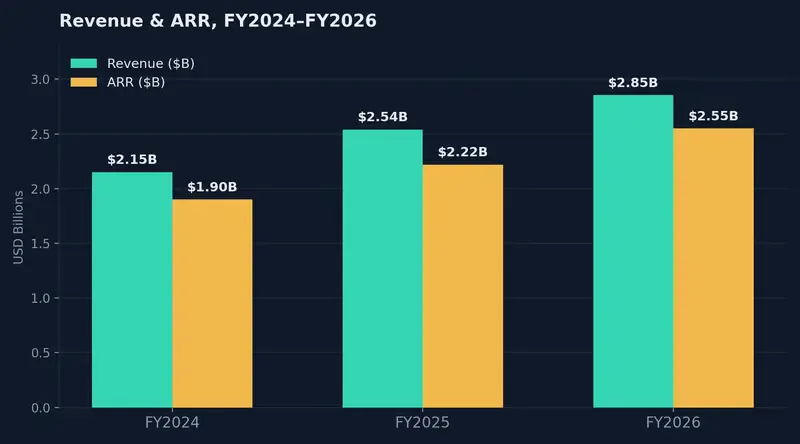
Source: Nutanix quarterly and annual SEC filings / investor releases, FY2025–FY2026.
Free cash flow tells a similar story: $750 million in FY2025 growing to $841 million in FY2026, a 29%
margin, alongside a 106% net dollar retention rate at the end of the fiscal year — meaning existing
customers are, on balance, still expanding their footprint rather than shrinking it.
05 — SECURITY & RESILIENCE
Security defaults have tightened, not just features
The original article framed security mostly in terms of encryption, access controls, and disaster recovery — all still present. What’s changed is the default posture: AHV 11.2 now ships with external SSH access to hosts disabled out of the box, requiring administrators to route through the Controller VM instead, and adds cluster-wide console access controls. Combined with continued expansion of ransomware-signature detection in Nutanix Files, the direction is toward a more locked-down default state rather than security being an opt-in configuration step.
SECURITY HEAD-TO-HEAD
Nutanix Flow vs. VMware NSX: two different security philosophies
Beyond default settings, the more consequential security difference is architectural. Nutanix bundles Flow Network Security — microsegmentation, zero-trust default-deny policies, and virtual-private-cloud-style network isolation — with every Nutanix Cloud Infrastructure edition except the entry Starter tier, at no separate licence line. VMware’s equivalent, NSX, is functionally mature and carries a larger installed base, but since the Broadcom repricing it is no longer sold as a standalone product; it is only available bundled inside VMware Cloud Foundation, which pulls in the rest of the VCF stack whether an organization needs it or not.
● Blast-radius containment: Flow’s default-deny, application-centric policies are explicitly designed to limit lateral movement during a ransomware event, isolating infected VMs at the network layer rather than the host layer.
● Operational simplicity: Nutanix promotes one-click, full-stack upgrades across the cluster; VMware’s own documentation lays out a multi-step vSphere upgrade process with separate procedures for vCenter, ESXi hosts, and VMs, and Security Technical Implementation Guides (STIGs) are published as separate hardening steps rather than built into defaults.
● Data protection: Nutanix Data Lens provides built-in anomaly detection and forensics for ransomware and permission-risk events; VMware’s equivalent capabilities are spread across a suite of separate products, which independent reviewers note can add cost and integration complexity.
● Independent standing: on PeerSpot’s 2026 microsegmentation rankings, VMware NSX still holds a larger market mindshare (14.7% vs. Flow’s 6.8%) and a marginally higher average rating, but Flow users report a notably higher willingness to recommend the product (100% vs. 88%) — consistent with the broader pattern of VMware being respected for maturity while Nutanix scores better on simplicity and value.
Bottom line: VMware NSX is the more feature-complete, battle-tested networking security product. Nutanix Flow is the more accessible one — included rather than upsold, and built around a smaller, more opinionated policy model. Which matters more depends on whether your security team wants maximum configurability or fewer moving parts to secure.
HEAD-TO-HEAD
Major differences between Nutanix and VMware in 2026
Zooming out from individual features, five structural differences now separate the two platforms more
than any single capability gap:
| Dimension | Nutanix Cloud Platform | VMware Cloud Foundation (Broadcom) |
| Hypervisor licensing | AHV included at no separate charge | vSphere/ESXi bundled inside VCF subscription — cannot be licensed alone |
| Licensing metric | Per core or per node, tiered editions, storage capacity built in | Per physical core, 16-core-per-CPU minimum reported at some accounts, mandatory bundling |
| Contract model | Subscription, with per-node or per-core renewal | Subscription only — perpetual licenses eliminated; 20% penalty on late renewal |
| Networking security | Flow included with all editions except Starter | NSX only available inside VCF — no standalone purchase |
| Hardware flexibility | Nutanix software on Dell, Lenovo, HPE, and other certified OEM hardware, plus its own NX appliances | Broadcom-approved hardware compatibility list, narrower reseller/partner network after 2026 program changes |
| Support/partner access | Nutanix-direct and expanding partner network | VMware Cloud Service Provider program consolidated to a small number of invite-only partners in 2026 |
| Roadmap emphasis | AI infrastructure (Nutanix Enterprise AI), Kubernetes (Project Beacon), hybrid cloud (NC2) | Private cloud consolidation under VCF, continued vSAN/NSX integration |
COST COMPARISON
What the Broadcom repricing actually costs
This is the section that has changed the most since the original article. Broadcom eliminated VMware’s perpetual licenses in favor of subscription-only terms, collapsed roughly 8,000 SKUs into two flagship bundles (VMware Cloud Foundation and vSphere Foundation), and moved pricing to a per-core model with a minimum of 16 cores licensed per physical CPU — a floor that distributor and advisory reports say was briefly pushed as high as 72 cores at some accounts before settling back toward the 16-core standard. On top of that, vSAN storage is metered separately above an included per-core allotment, and renewing even one day late reportedly triggers a 20% penalty with no grace period.
Independent licensing advisories that model three-year total cost of ownership on comparable clusters after the repricing put VMware Cloud Foundation 30% to 60% above an equivalent Nutanix Cloud Infrastructure deployment — largely because Nutanix includes the AHV hypervisor and storage software inside its per-core or per-node price rather than metering them as separate add-ons. One widely cited estimate found the subscription-based model costs roughly 63% more than the old perpetual-plus-support arrangement over a typical seven-year hardware lifecycle.
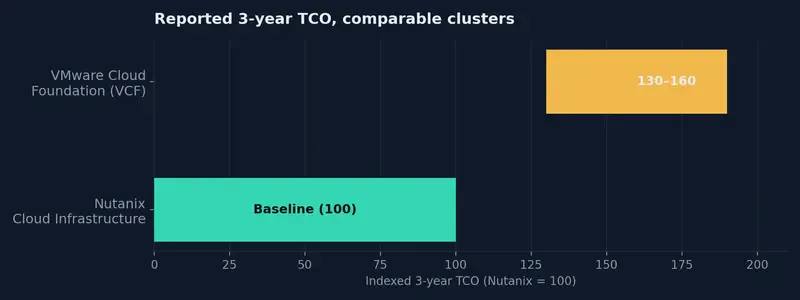
Indexed estimate from post-Broadcom licensing advisory analyses, 2026. Actual gap varies by discount tier, workload mix, and negotiated terms.
Important caveat: these are third-party licensing-advisory estimates, not vendor-audited figures, and the realized gap depends heavily on negotiated discounts, existing hardware, and migration costs — which one analysis estimated can consume 12% to 30% of the projected three-year savings.
The cost pressure shows up in how customers say they’re responding. A 2026 industry survey found the large majority of VMware customers are already taking action rather than simply complaining about it:
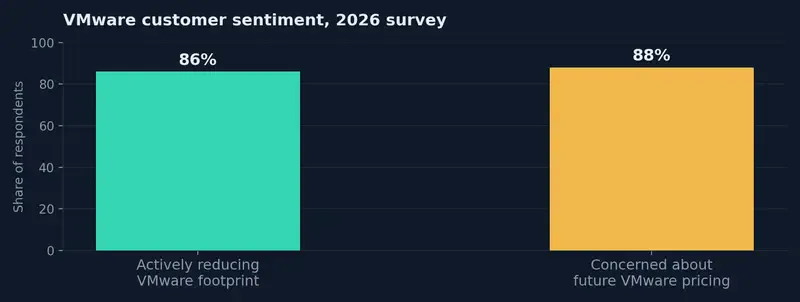
Source: CloudBolt Industry Insights Report, 2026 survey of VMware customers.
BEYOND THE ORIGINAL ARTICLE
What the 2021-era case didn’t anticipate: AI and Kubernetes
Nothing in the original comparison mentioned AI infrastructure or container orchestration, and that’s arguably the biggest gap between then and now. Nutanix Enterprise AI 2.8, released in August 2026, adds finer-grained access controls, object-level bucket policies based on name prefixes or tags, and new v4 APIs for automating data movement and storage backends. The company has also launched an agentic AI push, including a partnership with ChronoScale that combines GPU-as-a-service and “Token Factory” capabilities with a unified control plane for on-premises and sovereign AI deployments. Separate partnerships with Dell, NetApp, and AMD extend Nutanix software onto a broader range of existing customer hardware, which management frames as widening the addressable market without forcing a hardware refresh. Executives now describe Kubernetes and AI as the two topics increasingly dominating partner conversations that used to be entirely about VMware migration.
CUSTOMER FEEDBACK
What buyers are actually saying, not just what’s shipping
Independent reviews on Gartner Peer Insights give a more grounded picture than release notes
alone. Across the products with the largest review volumes, ratings skew strongly positive, though
not uniformly five-star:
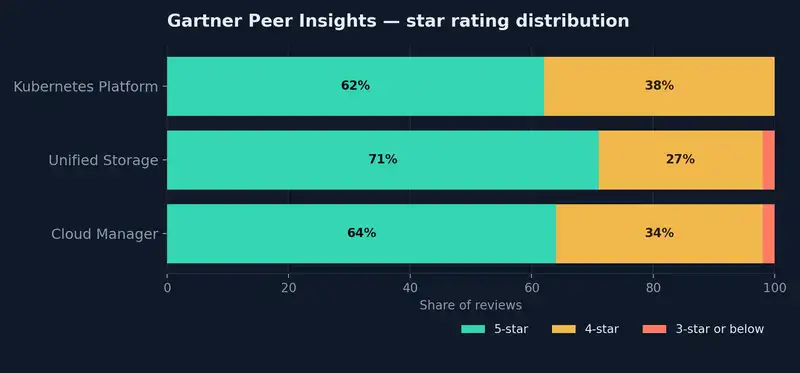
Source: Gartner Peer Insights product review pages, 2026.
“The AHV hypervisor is lightweight and stable, requiring minimal tuning compared to alternatives we’ve used before.”
— Infrastructure engineer, Nutanix Cloud Platform review, Gartner Peer Insights (904 reviews on this product)
The recurring critique across reviews isn’t reliability — it’s depth. Multiple reviewers note that advanced configurations carry a learning curve and that documentation could go further in certain areas, and container support within Nutanix Unified Storage is described as “still maturing but functional.” That’s a meaningfully different complaint than what VMware customers have been voicing about Broadcom, which centers on pricing and contract terms rather than product maturity.
SUMMARY
Original claim vs. 2026 reality
| 2021-era claim | 2026 status |
| Simplified management via Prism Central | Matured — VMware has closed most of the gap via VCF |
| Easier, modular scaling | Expanded — much higher per-node capacity, edge cluster flexibility |
| Better performance via HCI architecture | Refined — gains now come from protocol-level engineering |
| Lower cost / TCO | Reframed — driven by Broadcom pricing backlash, not just HCI design |
| Enhanced security & resilience | Tightened — secure-by-default configurations, not just added features |
| (not addressed in original) | New — AI infrastructure and Kubernetes now central to strategy |
THE RECOMMENDATION
Why organizations should consider adding Nutanix to their environment
None of this means every VMware shop needs to rip and replace overnight. But taken together — the licensing economics, the security defaults, the financial stability on Nutanix’s side, and the sentiment data on VMware’s — the case for at least piloting Nutanix in parts of the environment is stronger now than the architecture-only argument the original article made. Five reasons stand out:
● Licensing predictability: a per-core or per-node price that already includes the hypervisor and storage software is easier to forecast than a bundle where networking, storage capacity, and support renewals can each move independently — and where 88% of surveyed customers say they’re already unsure what next year’s VMware bill will look like.
● No forced bundling: Nutanix’s tiered editions let a team pay for the capabilities it actually uses; VCF’s all-in-one packaging means organizations that only need core virtualization are still paying for networking and management components bundled alongside it.
● Vendor financial stability: Nutanix enters this decision profitable on a GAAP basis, generating positive free cash flow, and growing ARR in the mid-teens percentage range — a materially different risk profile than a division inside a much larger acquirer that has already restructured its go-to-market twice in three years.
● Security that’s on by default: microsegmentation, locked-down SSH, and ransomware-focused data protection ship as standard inclusions rather than a menu of add-on products to license and integrate separately.
● A live, well-worn migration path: with Nutanix citing roughly 30,000 customers already moved and 400,000-plus ESXi VMs migrated, the tooling, partner expertise, and reference architectures for a VMware-to-Nutanix move are considerably more mature in 2026 than they were when the original comparison was written.
Where VMware still fits: organizations already committed to a full VCF footprint, deeply invested in NSX at scale, or running workloads with hard VMware-specific certification requirements may find switching costs outweigh the licensing gap, at least in the near term. The realistic recommendation for most enterprises is to price out a Nutanix pilot alongside the next VMware renewal, not to treat migration as automatic.
The honest caveat
Most of the migration and customer-count figures here originate with Nutanix itself, disclosed at its own events or in its own filings, and should be read with that in mind. VMware by Broadcom disputes the scale of the exodus its critics describe, and independent analysts note that the technical gap between the two platforms has narrowed enough that many organizations are staying on VMware simply because migration is disruptive, not because Nutanix lacks capability. The clearest, least disputable signal is Nutanix’s own financial performance — accelerating ARR growth, sustained profitability, and retention above 100% — which suggests the market shift is real, even if the exact customer counts are best treated as directional rather than precise.
SOURCES & REFERENCES
Compiled from Nutanix investor filings and press releases (FY2025–FY2026), Nutanix community release notes, Gartner Peer Insights, and industry reporting through August 2026.
Product & Platform Updates
Nutanix Community — AOS 7.6 Product Update https://next.nutanix.com/product-updates/aos-7-6-45767
Nutanix Community — Product Updates (incl. Nutanix Enterprise AI 2.8) https://next.nutanix.com/product-updates
en.vmik.net — Nutanix AOS 7.6, AHV 11.2, and Prism Central 7.6 Release Roundup https://en.vmik.net/2026/07/ntnx-aos76-ahv112-pc76-release/
rajpatel.co — What’s New in AHV 11.0, AOS 7.5, NGT 4.5, and Prism Central 7.5 https://rajpatel.co/?p=862
Financial Results
Nutanix, Inc. — Fourth Quarter and Fiscal 2025 Financial Results https://ir.nutanix.com/news-releases/news-release-details/nutanix-reports-fourth-quarter-and-fiscal-2025-financial-results
Nutanix, Inc. — Form ARS, Fiscal Year 2025 (SEC filing) https://www.sec.gov/Archives/edgar/data/1618732/000119312525246970/2025_ars.pdf
Nutanix, Inc. — Second Quarter Fiscal 2026 Financial Results https://ir.nutanix.com/news-releases/news-release-details/nutanix-reports-second-quarter-fiscal-2026-financial-results
TradingView — Nutanix Q4 Earnings Call Highlights (FY26) https://www.tradingview.com/news/marketbeat:abfbf2d49094b:0-nutanix-q4-earnings-call-highlights/
Pulse2 — Nutanix Q4 Operating Margin Nearly Doubles to 9.2% as Revenue and ARR Grow 16% https://pulse2.com/nutanix-q4-operating-margin-nearly-doubles-to-9-2-as-revenue-and-arr-grow-16/
Investing.com — Nutanix Q4 FY2026 Slides: Revenue Jumps 16%, Rule of 40 Streak Continues https://uk.investing.com/news/stock-market-news/nutanix-q4-fy2026-slides-revenue-jumps-16-rule-of-40-streak-continues-93CH-4848649
VMware Migration & Market Coverage
Nutanix — Broadcom to Nutanix Migration Promotion (official) https://www.nutanix.com/vmware-alternative/broadcom-to-nutanix-migration-promotion
SDxCentral — Nutanix CEO Targets Majority of VMware’s Customer Base https://www.sdxcentral.com/news/nutanix-ceo-targets-majority-of-vmwares-customer-base/
ChannelWeb / CRN UK — Nutanix CEO: VMware Migration Wave Has Years to Run https://www.channelweb.co.uk/news/2026/nutanix-ceo-vmware-migration-wave-has-years-to-run
ChannelE2E — As Broadcom Sheds VMware Customers, Nutanix’s CEO Pitches Migrations to Nutanix https://www.channele2e.com/news/as-broadcom-sheds-vmware-customers-nutanixs-ceo-pitches-migrations-to-nutanix
The IT Vortex — Nutanix vs VMware in 2026: Feature Parity After Broadcom https://www.theitvortex.com/how-did-nutanix-and-vmware-feature-parity-close-the-gap-in-2025-2026-heres-what-you-need-to-know/
Customer Reviews
Gartner Peer Insights — Nutanix Kubernetes Platform Reviews & Ratings https://www.gartner.com/reviews/product/nutanix-kubernetes-platform
Gartner Peer Insights — Nutanix Unified Storage Reviews & Ratings https://www.gartner.com/reviews/product/nutanix-unified-storage
Gartner Peer Insights — Nutanix Cloud Manager Reviews & Ratings https://www.gartner.com/reviews/product/nutanix-cloud-manager
Gartner Peer Insights — Nutanix Cloud Platform Reviews & Ratings https://www.gartner.com/reviews/product/nutanix-cloud-platform
PeerSpot — Nutanix Flow Network Security vs. VMware NSX (2026) https://www.peerspot.com/products/comparisons/nutanix-flow-network-security_vs_vmware-nsx
Security
Nutanix — Engineered Differently: Built-in Security Across Platform, Data, Network and Applications https://www.nutanix.com/blog/engineered-differently-built-in-security-across-platform-data-network-and-apps
Nutanix — Flow Network Security: Microsegmentation & Data Protection https://www.nutanix.com/products/flow-network-security
PeerSpot — Nutanix Flow Network Security Reviews (2026) https://www.peerspot.com/products/nutanix-flow-network-security-reviews
Licensing & Cost Comparison
Redress Compliance — VMware vs Nutanix: 2026 Cost Comparison https://redresscompliance.com/vmware-vs-nutanix-cost-comparison-2026
Redress Compliance — Nutanix vs VMware Licensing: 2026 Cost Gap https://redresscompliance.com/nutanix-vs-vmware-licensing-comparison
Redress Compliance — VMware to Nutanix Migration: 2026 Licensing TCO https://redresscompliance.com/vmware-to-nutanix-migration-licensing-tco
Redress Compliance — Broadcom VMware Licensing 2026: What Changed https://redresscompliance.com/broadcom-vmware-licensing-changes-explained
Firmographic — VMware Price Increase: What You Need to Know in 2026 https://firmographic.co/blog/vmware-price-increase
The Register — VMware Distributor Arrow Says Minimum Software Subs Set to Jump from 16 to 72 Cores https://www.theregister.com/2025/03/28/arrow_vmware_licensing_change/
The IT Vortex — VMware 2026 Price Increases: Broadcom Licensing and Options https://www.theitvortex.com/vmware-broadcom-changes-2026-cost-risk-private-cloud/
checkthat.ai — Nutanix Pricing: Plans, Costs & What You’ll Actually Pay https://checkthat.ai/brands/nutanix/pricing

No Comment! Be the first one.