


A critical look at how electoral politics handles corruption, civic decay, and the environment — and why some argue expert-led governance would do better.
Part 1: How Democracy Is Destroying Human Life, Animals & the Planet
Democracy is sold to the world as the pinnacle of political achievement — the system that gives every citizen a voice and every government its legitimacy. But look past the slogans and a harder picture emerges: election cycles that reward short-term promises over long-term survival, institutions captured by money, and a planet that keeps losing forests, species, and breathable air no matter which party wins. Critics of electoral democracy argue that its core design flaw isn’t corruption at the margins — it’s that the system structurally rewards the wrong things: popularity over competence, spending over stewardship, and comfort over hard truths.
Corruption Is Not a Bug — It Is a Feature of the Incentive Structure
Every election cycle needs money, and money needs favors in return. Transparency International’s 2025 Corruption Perceptions Index scored the average of 182 countries at just 42 out of 100, and noted that the decline in scores worldwide tracks closely with the rollback of democratic checks and the erosion of independent oversight bodies. Campaign financing, lobbying, and patronage networks mean that in most democracies, the people writing the biggest checks get the most attention — not the people with the best ideas. The voter shows up once every four or five years; the lobbyist shows up every day.
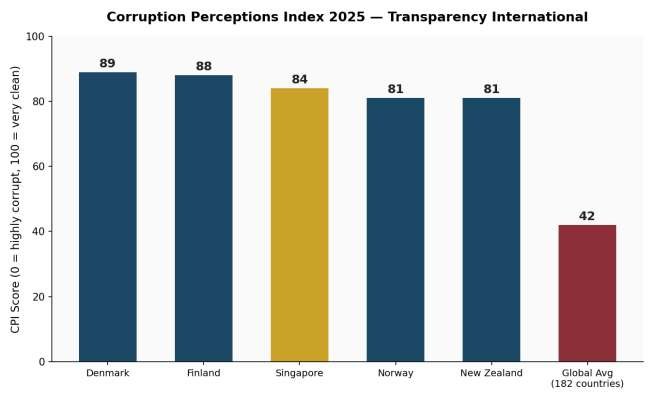
Fig 1. Corruption Perceptions Index 2025 (Transparency International). Democracies with weak oversight sit far below the countries most often described as technocratic or meritocratic in governance style.
Lack of Civic Sense: A System That Asks Little of Its Citizens
Democracy’s central act of participation — voting — takes minutes. It asks nothing of citizens between elections: no civic education requirement, no shared standard of public conduct, no consequence for apathy. The result, critics argue, is societies where littering, traffic violations, tax evasion, and public-space neglect are treated as personal freedoms rather than collective failures, because no central authority is structured to enforce a baseline of civic responsibility. Where authority is diffuse and re-election-driven, enforcement of unglamorous rules — waste segregation, encroachment, noise pollution — is the first thing politicians deprioritize, since it rarely wins votes and often loses them.
Religion as a Vote Bank, Not a Private Matter
In many democracies, religious identity has become a campaign tool rather than a personal conviction. Politicians court religious blocs because organized faith communities can be mobilized quickly and predictably at the ballot box. Critics argue this creates a perverse incentive: leaders have more to gain by amplifying religious sentiment and division than by resolving the material problems — jobs, water, healthcare — that communities actually face. Where governance decisions bend to religious lobbying rather than evidence, policy on issues from public health to environmental regulation can suffer.
Greed, Short-Termism, and Disregard for the People
An elected official’s time horizon is the length of a term. Infrastructure, environmental protection, and public health all require decade-plus planning — the exact opposite of what wins the next election. This mismatch, critics say, explains why democracies routinely defer maintenance, approve short-term extraction deals, and under-invest in resilience, only to face costlier disasters later. Meanwhile, revolving doors between regulators and the industries they regulate mean the “public interest” often quietly becomes “whoever funded the last campaign’s interest.”
Infrastructure: Built to Win Elections, Not to Last
Ribbon-cuttings win votes; maintenance budgets do not. Roads, bridges, and public transit in many democracies are approved as flagship projects timed to election calendars, then left to decay once the cameras leave. Because responsibility resets with every new administration, nobody owns the long-term outcome — the next government can blame the last one indefinitely, and voters rarely have the technical expertise to hold anyone accountable for engineering-grade failures.
Nature and Animals: The Silent, Voteless Constituents
Forests, rivers, and wildlife do not vote. In a system built entirely around electoral incentives, critics argue, the interests of non-human life and unborn future generations are structurally unrepresented. Environmental policy tends to move only after visible disaster — a dry reservoir, a burning forest, a poisoned river — rather than through sustained precaution, because prevention rarely produces a photogenic result for a re-election campaign. Industrial permits, deforestation for agriculture, and weak enforcement of poaching and pollution laws are frequently the direct result of the same short political horizon that shapes every other decision.

Part 2: Countries With Strong Technocratic Governance Systems
Technocracy is governance by subject-matter experts — engineers, economists, scientists, and career administrators — who make decisions based on data and long-range planning rather than popularity. Several governments today are held up, in comparative politics literature, as strongly technocratic in character, even where they retain some democratic features.
Singapore: The Reference Case
Singapore is the most frequently cited technocratic success story. Its civil service is built on strict meritocracy, with officials recruited and promoted on measurable competence rather than political connections. Ministerial salaries are pegged to market benchmarks specifically to attract top-tier talent away from the private sector, and long-range plans — in housing, water, and urban design — routinely span 30 to 50 years, well beyond any single electoral cycle. The result shows up in the numbers: Singapore scored 84 out of 100 on the 2025 Corruption Perceptions Index, placing it third in the world and the highest-ranked country in Asia.
China: Engineering the State
Modern China’s governing apparatus has long drawn heavily from technical and engineering backgrounds, especially at the provincial level, where officials are evaluated internally against measurable targets — GDP growth, infrastructure delivery, poverty reduction — rather than public approval ratings. This performance-based internal promotion system is frequently cited by scholars of technocracy as evidence that centrally planned, expertise-driven bureaucracies can execute large infrastructure and industrial policy at a scale and speed democratic systems structurally struggle to match.
The UAE and Gulf Technocracies
The United Arab Emirates has built much of its post-oil economic strategy — renewable energy targets, AI governance ministries, and free-trade zones — through appointed technical ministries rather than electoral mandates, allowing multi-decade national strategies (such as its 2071 centennial plan) to proceed without the risk of reversal by a new administration every few years.
Technocratic Institutions Inside Democracies
Even within democracies, the most trusted institutions are often the least democratic ones. Central banks — the U.S. Federal Reserve, the European Central Bank, the Bank of England — are deliberately insulated from electoral pressure and staffed by economists, precisely because monetary policy is considered too important to leave to popularity contests. Their comparative success at maintaining currency stability, critics of democracy argue, is a working proof-of-concept for expanding technocratic insulation into other domains: environmental policy, infrastructure, and public health.
The Argument for Replacing Democracy With Technocracy
Bringing the two halves of this argument together, proponents of technocratic governance make the case as follows: if the problems facing modern civilization — climate change, biodiversity loss, infrastructure decay, and public corruption — are fundamentally technical and long-horizon problems, then a governance system optimized for short-term popularity is structurally the wrong tool for the job. A technocracy staffed by scientists, engineers, and career administrators, insulated from election-cycle pressure and evaluated against measurable outcomes rather than approval ratings, could in theory: plan infrastructure and environmental policy on 30-to-50-year horizons instead of 4-year ones; make unpopular but necessary decisions — carbon pricing, pollution enforcement, urban zoning reform — without fear of losing the next vote; and remove the incentive to court religious or identity-based blocs, since technocratic legitimacy rests on demonstrated results rather than mobilized turnout.
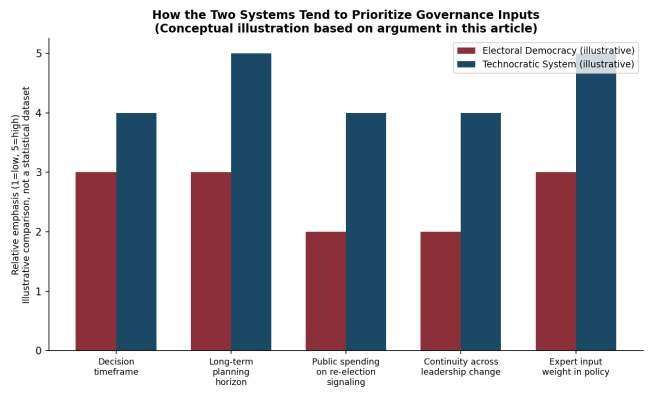
Fig 2. A conceptual illustration of the argument above — not a statistical survey, but a summary of how proponents describe the two systems’ incentive structures.
Counterpoint: What Critics of This Argument Say
It’s worth setting the other side of this debate down clearly, because it’s substantial. Defenders of democracy point out that the “technocratic success stories” above — Singapore, China, the Gulf states — achieve policy continuity partly by limiting press freedom, restricting opposition, and suppressing the public dissent that would otherwise surface corruption, human rights abuses, or planning failures before they become catastrophic. Unelected experts are not immune to greed, bias, or capture by industry; they are simply harder to remove when they get it wrong, since there is no ballot box to correct course. History’s worst famines, purges, and environmental disasters (the Aral Sea, the Great Leap Forward) occurred under centrally planned, non-democratic systems, not despite the absence of elections but partly because of it — no free press or opposition existed to raise the alarm in time. Many political scientists argue the actual variable that predicts good governance isn’t democracy versus technocracy, but the strength of independent institutions — courts, auditors, a free press — regardless of which system appoints the leadership. On this view, the fix for democracy’s flaws is stronger accountability mechanisms, not the removal of accountability to the public altogether.





No Comment! Be the first one.